
By Visions Art | October 2026
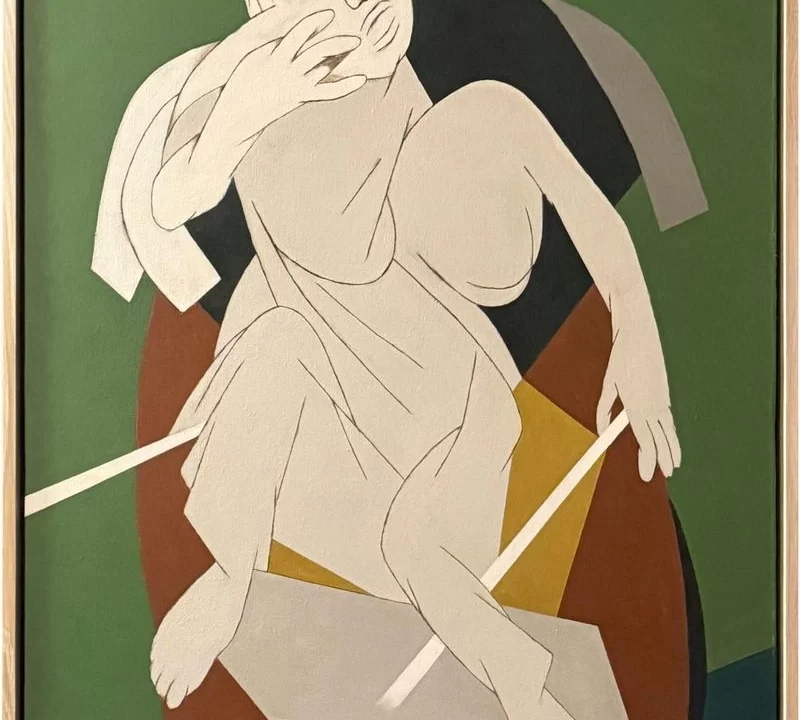
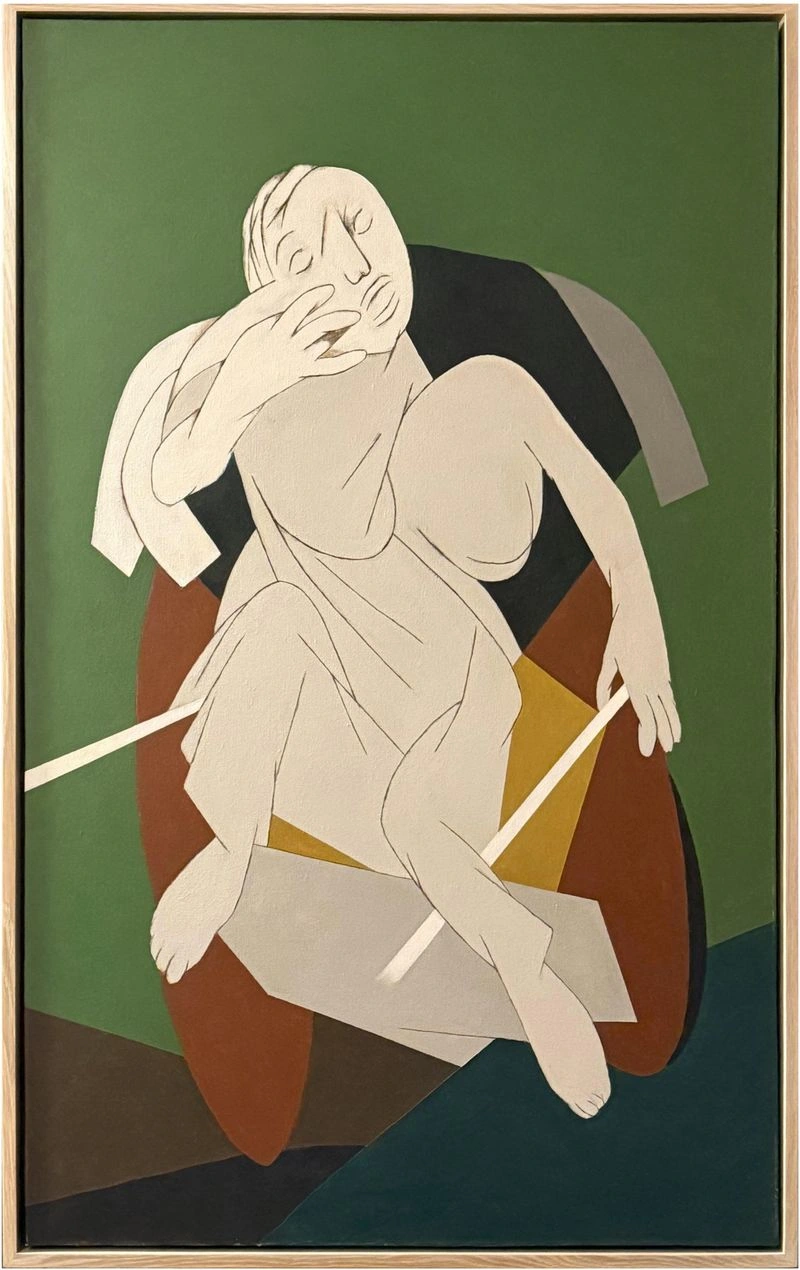
A rickshaw puller. A man bent by labour, reduced by circumstance, made monumental by paint. When Tyeb Mehta first fixed his gaze on this figure — the invisible worker threading through Bombay’s streets — he was making an act of witness. When that same image sold on 11 October 2026 for ₹69.1 crore, the world was doing something different. It was making a valuation.
The distinction matters. And understanding it tells us more about where Indian art stands today than any single number can.
A Record Built on Decades of Reckoning
The ₹69.1 crore sale of Tyeb Mehta’s Rickshaw Puller (2002) is not an isolated event. It is the latest peak in a sustained upward curve that, viewed in full, reads less like a market anomaly and more like a long overdue correction.
The work — an acrylic on canvas painted in the final decade of Mehta’s career — sold at the inaugural auction of Volte Una, a new single-lot platform founded by Tushar Jiwarajka that offers significant artworks individually rather than as part of large catalogues. It attracted multiple bidders in the final minutes before the auction closed, surpassing the previous world auction record for Mehta set just six months earlier: ₹61.80 crore for Trussed Bull (1956) at Saffronart’s 25th Anniversary Live Sale in Mumbai in April 2025. Rickshaw Puller is now the fourth-most expensive Indian artwork ever sold at auction in rupee terms.
Mehta’s auction trajectory has been one of modern Indian art’s most closely watched stories. As far back as 2008, Untitled, Figure on Rickshaw (1984) had sold for USD 1.91 million. But 2025 and 2026 have been something qualitatively different. In April 2025 alone, Trussed Bull fetched $7.2 million at Saffronart and Untitled (Diagonal) from 1973 sold for $6.8 million at AstaGuru in Mumbai — Mehta’s first and second highest auction prices at the time, achieved within weeks of each other. The ₹69.1 crore Rickshaw Puller has now reset the ceiling again.
For context: in any given year, just two major Mehta works may be offered at auction and two more privately. This is a market operating on scarcity. Every significant canvas that comes to auction carries the weight of a generation’s worth of accumulated desire.
What the Rickshaw Puller Means
It would be a mistake to read these prices purely as financial data. Tyeb Mehta (1925–2009) was, before anything else, a painter of conscience. A sensitive artist deeply affected by the plight of people on the social periphery, his intense paintings convey the trauma and violence he saw around him — through anguished human figures, trussed bulls, falling birds and the rickshaw puller, a motif he returned to across his career.
The rickshaw puller is not incidental to Mehta’s oeuvre — it is central to it. The figure depicts a man in a moment of repose, his gaunt form and weary presence capturing the harsh realities of manual labour. Mehta’s treatment transcends mere representation, offering a commentary on social inequity and the human spirit’s capacity for endurance. That a work so rooted in the specific textures of Indian urban struggle now commands the highest tier of the global art market is, depending on your vantage point, either deeply ironic or deeply appropriate. Perhaps it is both.
What it is certainly not is coincidence. Collectors and institutions are not paying ₹69.1 crore for sentiment. They are paying for the recognition that Mehta solved problems in paint — of form, of movement, of moral witness — that very few artists of any nationality have managed with equivalent economy and power.
A Year That Changed the Conversation
2025 and 2026 will be remembered as the period when Indian art stopped asking for a seat at the global table and simply occupied one. The evidence is systemic, not anecdotal.
In March 2025, M.F. Husain’s Untitled (Gram Yatra) sold at Christie’s New York for ₹118.7 crore ($13.75 million) — a new record for modern Indian art and the highest price ever achieved by an Indian artist at international auction. Weeks later, Saffronart’s 25th Anniversary Live Sale achieved a total of ₹245 crore across two sessions — a world record for the highest-value auction of South Asian art by an Indian auction house. The Trussed Bull was the centrepiece of that sale, selling for ₹61.80 crore — nearly nine times its higher estimate, with competition from ten bidders. Now, just months later, the Rickshaw Puller has surpassed even that.
These are not the numbers of a niche market finding its footing. These are the numbers of a market arriving at maturity.
The Infrastructure Behind the Numbers
Records do not happen in isolation. Behind every ₹69.1 crore sale is an ecosystem that has been quietly, persistently building for two decades.
India’s auction houses — Saffronart, AstaGuru, Pundole’s — have professionalised the domestic art market from within, developing international-grade provenance research, digital bidding infrastructure and collector relationships that now span continents. The emergence of Volte Una, with its single-lot format and significantly reduced buyer’s premium, signals that the market is also innovating structurally — finding new models better suited to the level at which Indian art now trades.
Institutional validation has followed. Museums in India — the Kiran Nadar Museum of Art, the National Gallery of Modern Art — are now active, competitive bidders at auction rather than passive recipients of donations. When a museum bids against a private collector, it signals that the work has passed into the category of the irreplaceable. International collectors have taken note: the sale of Mehta’s Rickshaw Puller at Christie’s in the early 2000s attracted an international first-time buyer, an early signal that Western collectors were beginning to recognise the gap between the prices of Indian masters and their counterparts elsewhere in the world. That gap has been closing steadily ever since.
What This Means for Contemporary Indian Art
Here is where the conversation must extend beyond Mehta and the modernists who defined Indian art’s first international chapter.
The records being set for Mehta, Husain, Raza and their generation create something essential for every artist working in India today: a narrative. A demonstrated truth that Indian art — rooted in Indian experience, made in Indian cities, circulated through Indian galleries — can hold its own against any art produced anywhere in the world.
This matters for the contemporary generation differently than it mattered for the modernists themselves. The Progressive Artists’ Group worked largely without the validation of global markets; they built a visual language in the face of institutional indifference. Today’s Indian contemporary artists inherit a market that has been prepared for them by the very price records we are discussing.
The collector who pays ₹69.1 crore for a Tyeb Mehta is not only buying a Mehta. They are buying into a thesis about Indian art’s place in the world. And that thesis, once held, tends to extend. Collectors of Indian modernism become collectors of Indian contemporary art. Institutions that acquire Mehta begin to ask what comes next. Galleries that can point to the ₹69.1 crore room have a different conversation with potential buyers of emerging work than they had five years ago.
The Space Being Made
Contemporary Indian art is not waiting for permission to claim its place in the global art market. It is building that place, sale by sale, exhibition by exhibition, gallery relationship by gallery relationship.
The evidence is visible across the ecosystem. Indian artists are being shown at Art Basel, Frieze and the Venice Biennale not as representatives of a regional curiosity but as participants in conversations that transcend geography. Indian collectors are acquiring international work while simultaneously driving domestic prices to levels that attract international attention in return. The flow is now genuinely bidirectional.
What the ₹69.1 crore Rickshaw Puller confirms — alongside the Husain at Christie’s, the Trussed Bull, the Diagonal — is that the global art market has resolved an ambiguity it carried for decades. Indian art was never a secondary tradition. It was a tradition the market had not yet caught up with. That gap is closing. In some categories, it has already closed.
The rickshaw puller, in Mehta’s hands, became a universal figure — a body that carries weight, that moves through the world bearing other people’s loads. It is not a stretch to say that Indian art has spent decades doing something similar: carrying the weight of a rich, complex, undervalued tradition, moving steadily toward a moment when the world would stop and look, and recognise what it was carrying, and name a price worthy of it.
That moment is here. The next question is not whether Indian contemporary art will follow. It is how quickly, and how far.
Visions Art is a contemporary Indian art gallery established in 2003, located at Opera House, Mumbai. The gallery represents a curated selection of artists working across painting, sculpture and mixed media.
