

In his monograph on Manaku, art historian BN Goswamy reconstructs the life and art of the 18th-century Pahari painter
When BN Goswamy introduced us to the complete portfolio of Nainsukh in 1997, the miniature painter from the hills of Punjab was a relatively little-known entity in the contemporary art world. Goswamy’s discerning biographical sketch not only brought him recognition, but also became a handbook for Nainsukh’s work. Two decades later, the art historian has dedicated a publication to Nainsukh’s elder brother, Manaku. Like his sibling, Manaku, too, was a master practitioner, who painted evocative miniatures and carried forward the tradition inherited from their father Pandit Seu, a leading painter in Guler, a small state in the Punjab hills, at the turn of the 18th century. Unlike Nainsukh, who had several patrons, such as Raja Balwant Singh, Manaku is not known to have a specific patron.
“The project is very close to my heart from the very beginning. Manaku was an extraordinary painter,” says Goswamy, 84. He confesses to being partial to Manaku, who is considered more “conservative” than Nainsukh. It was, after all, his Hiranyagarbha, the depiction of the cosmic egg (considered the seed of all creation) in an opaque watercolour, which Goswamy declares as one of the greatest works of Indian art, also included in his 2014 publication The Spirit of Indian Painting: Close Encounters with 101 Great Works, 1100-1900.
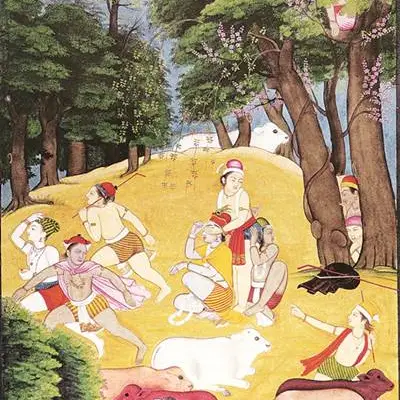
The illustration belongs to one of Manaku’s acclaimed folios, the Bhagavata Purana, which the Pahari artist is believed to have painted on the sheer basis of its style. “I am convinced that Manaku moved to the realm of the gods at night, conversed with them as if they were equals, and came back in the mornings,” said Goswamy, during the Delhi launch of the publication titled Manaku of Guler: The Life and Work of Another Great Indian Painter from a Small Hill State.
 One of Manaku’s works published in the book
The narrative in the 512-page book begins from where Goswamy’s own research on artistic traditions began in the 1960s. In an article published in the journal Marg in 1968, titled “Pahari Painting: The family as the basis of style”, Goswamy had argued that stylistic differences in Pahari paintings can be better understood if connected to artists’ families rather than only to princely patrons. An important source for him were the genealogical records or registers of visitors maintained by the pandas or priests in Haridwar, Varanasi and Kurukshetra. “I remember going to Haridwar as a child with my father and writing my name in English and misspelling it,” says Goswamy, adding, “But that got me thinking that pahari painters would also have been pilgrims. Pahaad mein kehte hain ki aap jeeteji Haridwar na gaye, toh mar ke aap zaroor jaayenge. (In the mountains, they say, if you didn’t go to Haridwar in your life, you will go there once you’re dead).”
He found one entry for Manaku, in the register of Sardar Ram Rakha, a tirtha purohit in Haridwar. Reproduced in the book, here Manaku notes that he is a native of Guler, a carpenter, son of Seu, and grandson of Hasnu. While this two-line entry is the only text in the hand of Manaku that has survived, Goswamy also presents two portraits of him that are known to exist — both tinted brush drawings; one where Manaku is estimated to be close to 40 years of years, ascribed to Nainsukh, and another from the National Museum collection, where he looks visibly older.
 A portrait of Manaku from the book
In the publication, Goswamy chronicles and discusses each work produced by Manaku according to the one anchor for which he has precise dates: the ‘Gita Govinda’ series — based on poet Jayadeva’s 12th-century Sanskrit love lyric — dated 1730. Every known work by the artist has been recorded in the monograph. Among the earliest is the ‘Siege of Lanka’ series, which, Goswamy infers, could have been a continuation of the ‘Ramayan’ series left unfinished by Manaku’s father, which he adopted on a grander scale.
Manaku gave it “a certain naturalism in the treatment of figures and faces”, but never completed it, and the last few folios were brush drawings in black on uncoloured paper (like in the case of the Bhagavata Purana). Goswamy draws similarities between this set and his next, the ‘Gita Govinda’. “There is much in common between these two series; from the broad, red borders and thin rules and the generally neatly inscribed verses in Devanagari at the back, to the flat, monochromatic backgrounds, high horizons, boldly stylised trees and arbitrarily placed curving rims suggestive of planes in the background,” he writes in the book.
Author of over 25 books, Goswamy, however, does not reject conflicting arguments. Instead, a section in the book is dedicated to the writings of other scholars on Manaku. “I am not holding anything back. As an art historian, I feel responsible to present the different sides,” he says.
Written by Vandana Kalra | Published:September 25, 2017
http://indianexpress.com/article/lifestyle/art-and-culture/an-uphill-task-bn-goswamy-art-historian-manaku-painter-4859527/
