

 |
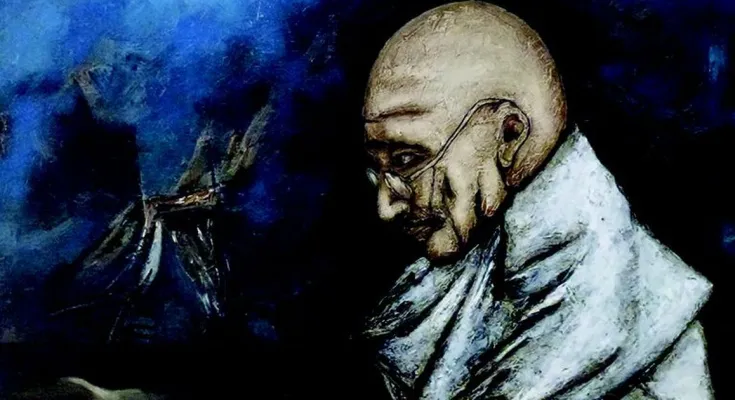
| Portrait of Gandhi | Credit: Manu Parekh. Courtesy: Manu Parekh: Sixty Years of Selected Works, Aleph Book Company. |
Annapurna Garimella: What does it mean to be an artist working in his seventies? You started painting when you were sixteen and have been making art for seven decades. What does making art mean to you today?
Manu Parekh: My first reaction to your question is that I still feel excited. I feel – I can see – that there is space to create many things. As an Indian, in this kind of an environment, there is a great deal of possibilities, a lot of inspiration, as well as a lot of issues.
What do you mean by ‘as an Indian’?
In India, the most interesting thing for me is the Indian mind. If I am a Gujarati, then I will look at things from a Gujarati angle, and so on. But I also feel that I am a popular culture man, influenced especially by the world of Hindi films, from which a person of one culture can learn about other cultures. Moreover, because of my involvement with craft and theatre, I learned about other [Indian] cultures, so I never fully feel that I am only from Gujarat and can only enjoy that. I have been fascinated by people of other states and cultures, and have been fortunate to travel all over India. That is why I used the words ‘as an Indian’.
The other thing, which is a treasure chest, is what is in the rural areas. The sensitivity that is there, even the problems that are there, the ways of making them better, their way of understanding, the relationship between men and women, especially between women; in urban India, there is not much knowledge about this. Interestingly, the popular film feels rich to me – because of the way it has absorbed various influences (especially those from vernacular cultures and rural milieus) – this is the real India [the rural areas]…if one wants to enjoy India.

Perhaps right from your childhood, from the beginning of your interest in art, these things must have felt interesting…but the perspectives or directions that you saw, the fascination you had for village life, for instance, must be different now. You are talking about village life and the fascination it has for you, but that world does not exist anymore. Yes, a village is still a village, but the village has changed. So, what do you think about this? The shifts that happen in an artist’s life, the way Rabindranath Tagore saw a zamindari world and over time his thoughts changed, and then he chose not to participate in Congress-style nationalism but instead he began to bring something of the Santhals who lived in the villages around him into the institution he founded in Santiniketan, and at the same time he was also aiming for and desiring a universal humanism, a very Modernist way of thinking. Souza too started in Mumbai and then went to London and left that and went to New York, then kept returning to a transforming India (Goa too had changed in this time). What has happened to you between age sixteen and the present that has impacted your art and your thinking?
First of all, I am not from a village. I am from Ahmedabad. My connection to the village is through my grandmother who lived near Nadiad, where we went during our summer holidays and through Madhvi, my wife, who is from a village as well.
My father was a barber. The way his hands moved was miraculous, it was craft. He was a great film and theatre buff – he gave this to me as my inheritance. From about age eight, I began to go to the movies with him.
We always bought the lowest priced ticket. Once we went to see Dilip Kumar’s film ‘Shaheed’ and when we reached the window after being in line, it was sold out. My father asked, ‘Shall we sit in line for the next show?’ That was his nature, he was passionate.
When I got the Padma Shri, Dilip Kumar was sitting in front of me in the Durbar Hall of the Rashtrapati Bhavan. When we came out, and a crowd surrounded him, I stood apart, lost in thought. I was back at Kishan Cinema on the footpath and was thinking about that day with my father. Both he and Madhvi’s father, a Gandhian, whom I knew since I was twelve, have been such big influences in my life. In the days when I went to J. J. [School of Art], there were only two places that attracted me – Paris and Kolkata. I had a huge attraction to these cities; Kolkata because of painting, theatre and Rabindranath Tagore, who I already felt was a great painter. When I reached Kolkata in 1965, and would argue the case for Rabindranath as a great painter, very few would agree or accept – there was a doubt about his status as an artist. Today he is accepted.
Jaswant Thakkar, the great theatre actor, introduced me to Tagore’s Muktadhara, which we staged in Gujarati for Tagore’s birth centenary (I was twenty-five and played the role of eighty-year-old Viswajit). Because of Jaswant Thakkar’s involvement with the Indian People’s Theatre Association, many of its members were very friendly with us; whenever Prithviraj Kapoor or Balraj Sahni came to town, they came to meet us and I have rehearsed in front of both of them. IPTA and its members had a great impact during that period, the Communist Party was not divided and socialist thinking inspired work like Balraj Sahni’s Do Bigha Zameen and the works of Shailendra, Sahir Ludhianvi and Inder Raj Anand (the screenwriter for many of Raj Kapoor’s films).

What was the impact of IPTA on your art?
In 1963, I joined the Weavers Service Centre, an initiative of the All-India Handloom Board, under the leadership of Pupul Jayakar. To leave the theatre world and then take up the job – I only ever had one – in craft was the impact of both Gandhian thinking as well as IPTA. To understand the problems of village people…
Are you bothered by the changes in Indian art?
No. When I started making money from painting, people criticized me a great deal. I appreciated that and I used that criticism. Many people never could do substantial work because of which they struggled financially all the time. Because of the changes, I was able to paint full-time.
Excerpted with permission from Manu Parekh: Sixty Years of Selected Works, by Manu Parekh, Aleph Book Company.


https://scroll.in/magazine/851409/artist-manu-parekh-on-the-art-market-rabindranath-tagore-and-pop-culture
